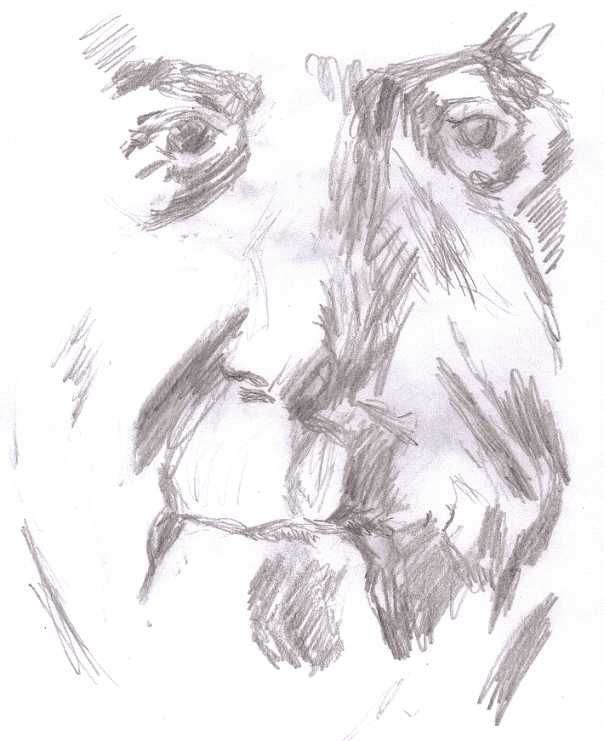
As you've just seen, some will go to great lengths to secure an interview
with Harry Bell. It would still have been worth it, even if Joanna had had to turn
to alien abduction; luckily, she didn't. Now, from Harry Bell, your host on
Boogie Street, you can learn what the aliens wanted to know, plus even more.
Joanna: Mentioning you liked how your paintings were hung (at an exhibition),
you caught my attention.
Can you explain what you look for in a good "hanging" of a painting, and
on the other hand what might disappoint you about how a painting is hung?
Harry:Hanging an exhibition is never simply a matter of just putting paintings on
a wall and this is particularly so when the show is made up of several
artists' work. For instance, putting a painting of muted quiet colour next
to a vibrantly coloured one isn't fair on either, but especially unfair on
the quiet one. The person doing the hang should also take into account the
size and shape, as well as the colours of the painting. It's a tricky
business.
My worst experience was to go to an open-entry exhibition which had been
hung in a church, to find one of my paintings hanging from a bit of frayed
string over the corner of a protrusion on a stone pillar.
Joanna: I notice you got your BA (honours) in 2001, yet you've drawn your
whole life and painted seriously since 1989. Therefore, here's my
two-pronged question:
a) Is art something you might learn just as easily later in life as in
childhood?
Harry: I don't believe there should be any age barrier to learning to make art.
Every child makes pictures but it's only when they're older that they begin
to think there's a *correct* way of doing so. It's then that the majority
give up. While there's no doubt that some people have greater natural
aptitude, in the same way that some people are better with words, others
with arithmetic, etc., there's no reason at all that someone who wants to
shouldn't take up art and with *genuine effort*, improve on their ability.
One of my tutors liked to say "There is only art", by which he meant that a
painting by an amateur painter was just as valid as one by Degas, provided
both approached their painting with equal seriousness. The amateur should
not think that because they're amateur they need not put every effort into
their work.
b) Regarding art, how much can be learned from a teacher, as opposed to
being learned from personal trials?
Harry: My experience makes it difficult for me to answer this fully. Before going
to University, I benefited from critical advice from a tutor who was not
himself a particularly adept painter. His expertise was as an art critic
and he was able to guide me in my development by pointing out problems of a
non-technical nature and suggesting ways forward.
On the other hand, the tutors I encountered at University were mostly
rather average painters and actually tried to deter me from pursuing
painting . Despite not being really Conceptualists themselves, they saw
that as the current vogue and urged all their pupils down that path. As a
consequence, I was forced to plough a lone furrow.
Joanna: I notice in your paintings you use both curves and angles.
Some artists appear to prefer angles; others prefer curves. Do you have a
preference?
Harry: Not especially, but having spent a large part of my career painting
buildings, I've naturally been constrained by the rectilinear nature of
those buildings. But before I began painting seriously, I was a cartoonist
for a long time. My preference in cartoons tended towards the curvy Warner
Brothers style rather than the spiky style of say, Ronald Searle, and I
suppose that preference still shows through whenever a painting calls for
it.
Joanna: Regarding "Tram With Prickly Pear",
(see the Vaporetti
Portfolio)
I knew it was a prickly pear
before even
glimpsing the title. However, looking closer, I noticed suggestions
of fruits (in fact, your painting shows me why that cactus is called the
prickly "pear" -
a connection I'd never made before). Examining the cactus closely, I see
watermelon, eggplant, plantain, and
of course pear. Do you? Furthermore, do you agree that a painting meant
to be about one
subject, can actually turn out to be about another as well?
Harry: I'm always happy to learn what others see in one of my paintings. Once I've
put it out into the world, I have no real control over what someone might
see in it. Some of my recent paintings (including the "Prickly Pear"
picture) have shown plants of various types. Plants allow greater freedom
in the mark making and I often find afterwards that images which were not
intentional start to emerge out of the marks .
I've often eaten the fruit of the prickly pear in Greece (although the one
in the painting is in Mallorca).. It has quite a delicate flavour and is
full of juice.
Joanna: I've got a bone to pick with you, Harry:) You say, in your Statement ,
that
producing a photgraphic image is never your aim. However, I did see some
photographic likenesses in some
of your paintings. Do you agree, and if so, which are your favourite
examples?
Harry: I still maintain that producing a photographic likeness is not an aim. I've
never really seen the point of Photorealsm, for example. Why would I want
to recreate the limited viewpoint and distortions of a photograph? Although
I often use photographs as source material, I always alter them by
cropping, collaging and by employing various computer techniques. When I
begin to paint, the source material which I've made provides me with a
starting point and the making of the painting takes over. Some of my
paintings may appear to be quite tight in their execution (and I admit to
that having become more so in recent years), but up close they can be seen
to be made up of quite loose marks. One of the problems of images on
screen, I suppose, is that this isn't always obvious.
Joanna: I notice your connection to science fiction, yet I didn't see any
paintings from you themed on sci-fi. (I confess I didn't see them all.) Can you explain?
Harry: I wish I could. Before I began to paint, I always thought that once I *did* begin, I'd be concerned with art of a fantastic nature and that
science fiction would make up a large part of it. But that never happened. I've
tried in the past to get into that field, but it simply hasn't worked for
me.
Joanna: Artists who use oil can produce an extra
3-d effect from the ridging
of the dry paint. Is this feature relevant, from
your point of view?
Harry: It's relevant to me, but not always. I've gone through periods of working
with impasto but at the moment I'm not too concerned with it. When I use
it, I'm not interested particularly in making a 3-D image as such, so much
as making a pictorial correspondence to the texture of the original image.
It's worth noting, however, that I would *always* take the opportunity to
work over an old painting (usually by using it upside down) because the
textures and colours of the old painting will inevitably influence the
construction of the new one.
(end of interview)
Harry Bell's web presence is significant. Besides the links already given, Joanna offers
his facebook
page. From there, he can guide you to his works.
Looking good, Harry. And remember...knowing the abduction really did happen
ought to make those dreams easier to tolerate, should they begin in a few months' time.